rBc Music Store
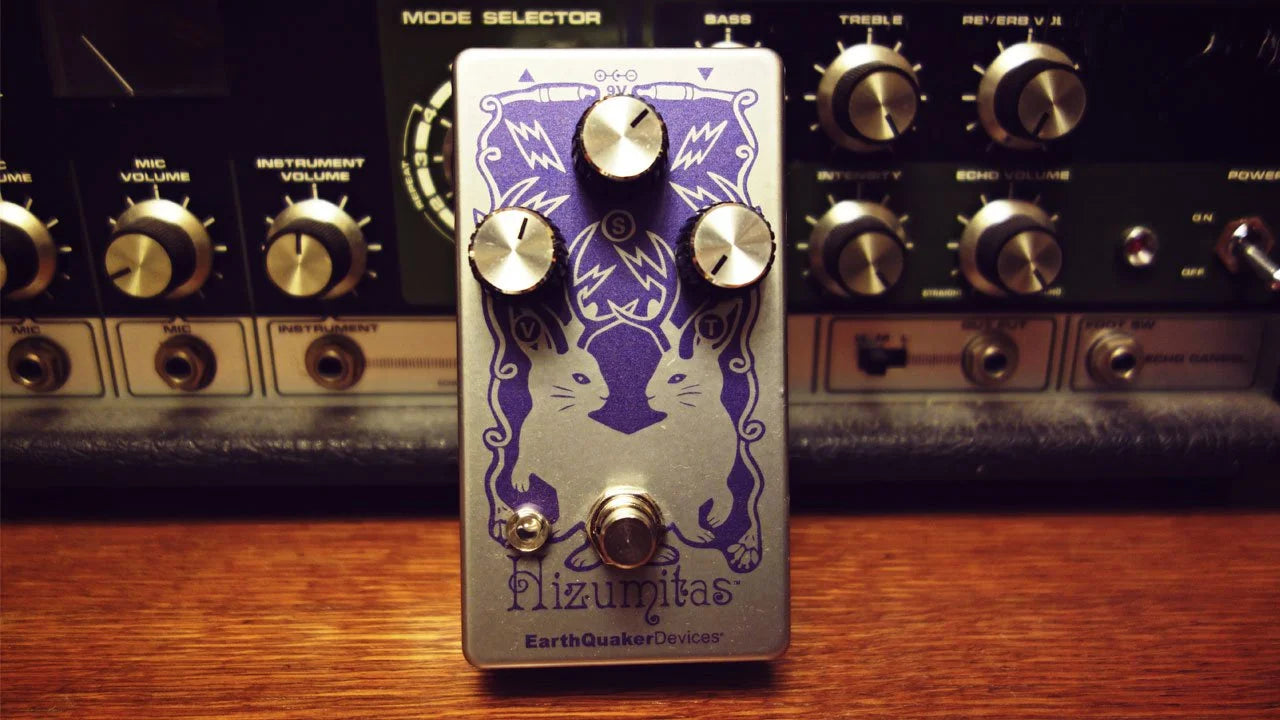
EarthQuaker Devices Hizumitas Fuzz Sustainer
EarthQuaker Devices Hizumitas Fuzz Sustainer
Call for details.
704-781-5600
Fuzz.
It’s the familiar sound of rock n’ roll and its many sub-genres. For non-rock fans, it may be the sound of that “CrazyGeetarMusic music,” but it pops up in all kinds of music. Sure, nearly every fuzz pedal circuit designer is in some way kneeling at the altars of pioneers, namely; the Maestro Fuzz-Tone, Tone Bender, Fuzz Face, and The Big Muff and decades of variants, but all fuzzes ain’t the same.
EQD currently has five fuzz pedals available, and they all bring something different to your sonic table. Check out our Fuzzcyclopedia blog post for a side-by-side comparison. Our newest fuzz is the Hizumitas, a simple three-knob wonder created in conjunction with Wata, guitarist of Boris. The Hizumitas is based on Wata’s beloved ELK BM Sustainar, one of the first Japanese clones of the Big Muff circuit and a staple on her pedalboard for years - until now. Wata uses the Hizumitas on Boris’ new album W, released in January on Sacred Bones Records.
No, the Hizumitas isn’t going to make your 1x8 Fender Champ sound as powerful as Wata’s stack of Orange 120 4x12s, but it will give your “heavy” sound more heft, and your screaming lead lines more ... scream.
As with all things music and music gear-related, there are hardcore fuzz aficionados who can listen to ten seconds of a particular pedal and tell you, “Oh sure, that’s a Ram’s Head BM from late December 1973. Sounds like one of the .047uf caps needs to be replaced, and the FS36999 transistor was manufactured in Southeastern China on a cloudy Tuesday.” Good for them.
For the rest of us noodlers, bedroom rock stars, weekend bar band and blues jam warriors, and any folks who just wanna RAWK alone or with friends on their instrument of choice, the minutiae of components and the long-debated concept of “vintage mojo” is likely not that relevant. In essence, “Fuzz pedal make guitar/bass and amp loud and scary! Hell YEAH!”
Still, you don’t have to be a fuzz expert to know what you want from a fuzz. Are you looking for a Jimi Hendrix, Pete Townshend late 60s or early 70s sound? Or perhaps your seven-string is drop-tuned to A, and you want that beefy stoner rock bottom end that alters your heart rate when standing too close to the amp. What about that sizzling treble-y near-death metal chainsaw tone? Yep, Hizumitas can get you in the ballpark.
It only has three knobs, but they are highly interactive. The Volume knob is pretty simple. It raises and lowers the volume of the fuzzed-out signal, with unity being around 10 o’clock. The Sustain knob kicks up the distortion, adding a hint of compression. At zero, the Hizumitas will give you a usable, lightly distorted sound. But as you crank it, the signal gets increasingly distorted but retains enough tightness to keep chords articulate. But the level of articulation depends on your Tone knob settings. The Tone knob isn’t just a basic treble roll-off or bass cut because from noon, turning the knob clockwise boosts bass frequency to a hefty bottom end, and turning it boosts the treble into near RAT territory.
The fun really starts when you begin fiddling with the Tone and Sustain knobs in tandem. If you’re new to fuzz and overdrives, we’d suggest putting all three controls at noon, picking your favorite power chord or riff, and just going nuts on your instrument until someone begs you to turn it down. Then play around some more, especially with the Tone and Sustain knobs, until you find your new signature fuzz-stortion tone.
We’ve compiled a few audio clips to give you an idea of the range of sounds the Hizumitas can provide on guitar and bass. The guitar used is a Partscaster with P90s using the neck pickup into an AMT V1 preamp (modeled on a Vox AC30) pedal. Then the signal hits the Mooer Radar Cab sim using its Vox AC15 cab and into the Focusrite 2i2 USB interface and Studio One 5 by PreSonus.
Couldn't load pickup availability